What you receive
Every report states the searched postcode, centre point, fixed 0.5 km radius, and month window, so you can see exactly what was included. The local figures are compared with the wider police force area and with England and Wales, using the same report period and the same published dataset. You also get a breakdown of how close records sit to your postcode, a chart of every crime category, a dedicated violent crime trend, and a summary of stop and search activity in the same circle. The PDF also explains where published police data is approximate - especially location points and outcome labels - so the report stays honest.
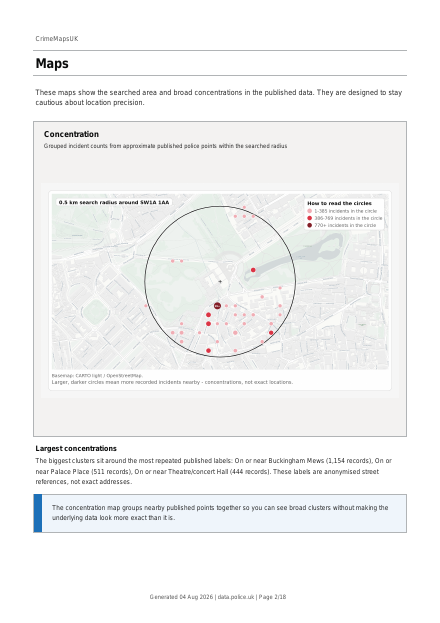
See where the incidents actually concentrate
The maps come right after the cover page. Published records rarely spread evenly: a handful of corners, parades, and cut-throughs usually account for most of the local total. The concentration map shows those clusters and names the most repeated location labels, and separate maps repeat the view for the largest crime types - so you can see, for example, where vehicle crime clusters versus where violent crime does.
Locations in published police data are approximate by design, and the map says so on the page. It shows broad concentrations, not exact addresses.
For a full walkthrough of how to read one, see How to read a neighbourhood report.
Sample reports
This is what you receive. Both samples use Westminster, London (SW1A) as the example area - the page set looks similar; the 5-year chart framing and appendix are the difference.
This is what you receive. Sample uses Westminster, London (SW1A).
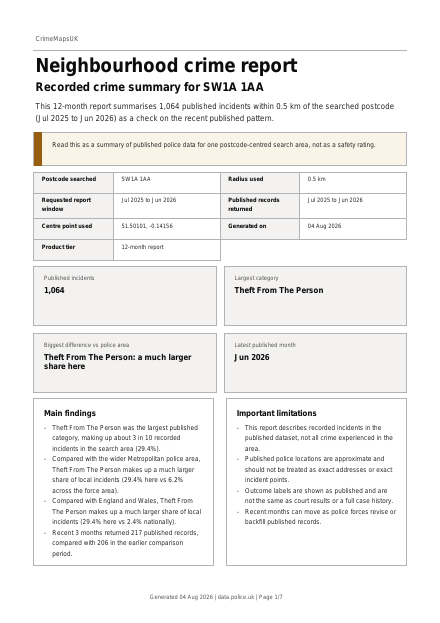 12-month sample (PDF)
Recent published pattern for one year
12-month sample (PDF)
Recent published pattern for one year
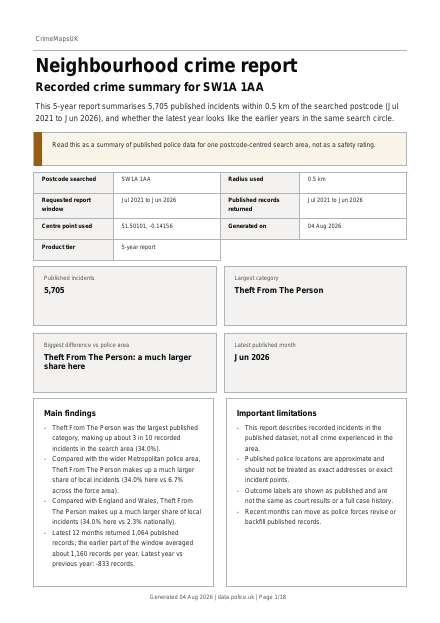 5-year sample (PDF)
Year-by-year volume plus a recent-records appendix
5-year sample (PDF)
Year-by-year volume plus a recent-records appendix
Report options
12-month report
£9.99
A recent check: is the last year quiet or busy in this 0.5 km circle?
Request this reportMost popular for a one-off check
5-year report
£19.99
Time depth: is the recent year typical against the earlier years? Includes a reference appendix of recent published records.
Request this report5 × 5-year reports
£79.99
Five single-use vouchers. Choose each postcode when you redeem. No expiry.
Buy this packEvery report uses the same fixed 0.5 km radius. After ordering, you receive a report reference - keep it; you use it on Find a report to reopen status and download pages later.
Where the data comes from
Data comes from the official police data portal (data.police.uk), run by the Home Office. Reports explain what the dataset can and cannot tell you, including reporting gaps and approximate location handling. Selling these reports is how the free dashboards, maps, and articles stay free - see the about page for how the service supports itself.